Most students revise more than they remember. The problem is rarely effort - it is method. After years of working with GCSE and A-level students, we see the same handful of habits separating those who retain what they learn from those who re-read the same page five times and remember none of it.
1. Test yourself before you feel ready
Retrieval practice - closing the book and writing down everything you can recall - is one of the most reliably effective study techniques in the research literature. It feels harder than re-reading, and that difficulty is precisely why it works. Every time you pull information from memory, you strengthen the pathway to it.
Try this: after each study session, spend the final ten minutes writing what you remember without notes. Check the gaps tomorrow, not today.
2. Space it out
Cramming works for about a week. Spaced repetition works for months. Reviewing a topic after one day, then three days, then a week, then a fortnight interrupts forgetting at exactly the right moments.
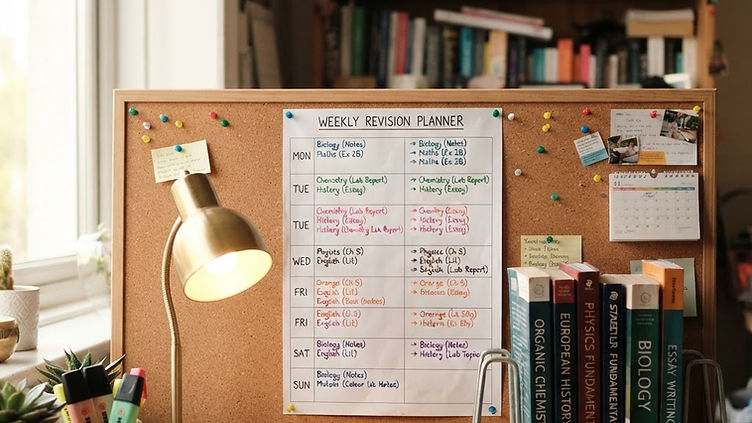
A simple rule of thumb: revisit each topic just before you would naturally have forgotten it. Anki and similar flashcard apps automate this, but a paper planner with dates works just as well.
3. Interleave your subjects
Blocked practice - finishing one topic completely before starting the next - feels productive but produces fragile learning. Mixing related topics within a session forces your brain to keep identifying which strategy each problem needs, which is exactly what an exam demands.
If you are studying Maths, alternate integration, trigonometry and mechanics problems rather than doing forty of the same type in a row.
4. Explain it out loud
If you cannot explain a concept simply, you do not yet understand it. Teaching the material - to a parent, a friend, or an empty room - exposes the exact points where your understanding is thin.
This is also the single best preparation for Oxbridge interviews, where success depends on thinking aloud under gentle pressure.
5. Sleep is part of your revision
Memory consolidation happens during sleep. A student who revises until 1am and sleeps five hours retains less than one who stops at 10pm and sleeps properly. Protect your sleep the way you protect your timetable.
Small changes to method produce larger gains than large increases in hours. If your child would benefit from structured support in building these habits, book a free consultation - we are happy to point you in the right direction, whatever you decide.